
In my last article, What is SEO?, I explained what Search Engine Optimization is and some related terms. In this post, I’m going to go over simple and easy things that anyone with a website can do right now to improve their on-page SEO.
First, what is on-page SEO? On-page SEO is optimizations done on your site. On-page. Off-page SEO is optimization not done directly on your site’s pages, like links to your site’s pages from authoritative sites.
Keywords
First up is keywords. Keywords are words or phrases that you want to rank for. A bakery in LA would want to show up for the keyword “LA Bakery.”
You want to use keywords in your title tag, headings, and content. This lets Google know that your page might be able to help the person searching “LA Bakery.”
Yet, you don’t want to keyword stuff, cramming in your keyword everywhere, even if it affects the quality of the page.
Sprinkle in keywords you want to rank for, but make sure your page retains its quality.
Meta Description
When you search for something, the results are generally shown in this fashion:
————————–Title————————-
——————-Meta Description—————–
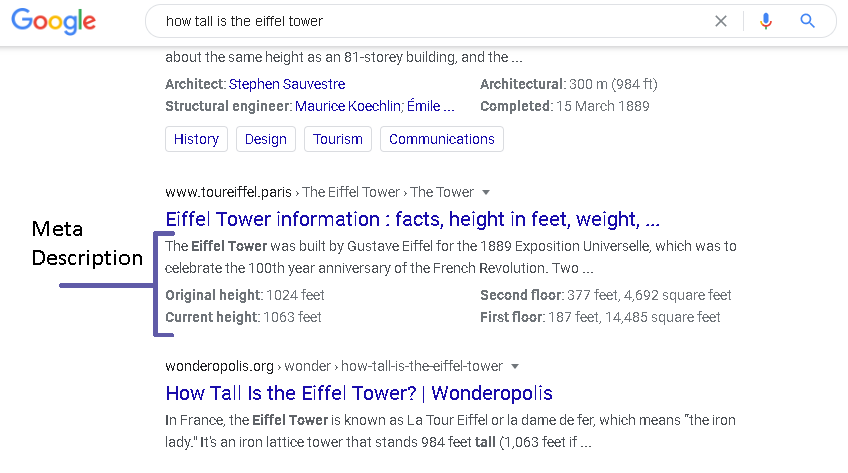
If you don’t have any text specified, Google will take some from your page. Yet, to take advantage of it, you can control what goes there yourself.
If you use WordPress, the free Yoast SEO plugin makes this and many other things simple. Go to the bottom of the page, to the Yoast SEO option, and add a meta description.
Other Content Management Systems normally have this as an option too. If you’re coding your own site, you’ll have to use a good ol’ fashioned <meta> tag. Put a <meta name=”description” content=”Your Meta Description here”> in the head of your page.
Make sure to use your main keyword and keep it short enough so it doesn’t get cut off!
Image Alt Text
Last, but not least, here’s another quick thing you can do to boost your on-page SEO.
There’s an attribute you can add to images called alt, short for alternate. It’s essentially a short description of what the image is. It’s shown if the image can’t load or if software is reading the page aloud.
It can also be used for SEO. An example would be the picture of me in my about page. I have the alt text as Noah Rousell Headshot 2020, this will help that page to rank on Google when someone types in “Noah Rousell.”
Use your keyword in alt texts, but if it doesn’t make sense, don’t use it. It should still describe the image.
If you haven’t read it already, here’s my first post on SEO. If you have any questions, I’d be glad to help you out, you can contact me here. Or, if you’d like someone to implement these tips and beyond for your site, set up a chat with me here.
Keep your eyes peeled for more SEO tips!
~ Noah